40ft Container Inclining Solar Frame — Cyclone-Rated, Actuator-Driven
Project Summary
Remote and off-grid power generation increasingly relies on solar arrays mounted to shipping containers — a practical solution that keeps the generation asset self-contained, transportable, and deployable without fixed infrastructure. The engineering challenge is creating a mounting system that does more than simply hold panels flat: one that can tilt to optimise solar capture, withstand the harsh conditions of the Pilbara, and return to a transport-safe position when the container needs to move or when a cyclone is approaching.
Liteforce engaged Elite Engineering WA to design and fabricate a complete inclining solar frame system for a 40ft container destined for Port Hedland. The frame needed to tilt solar panels up to 20 degrees for optimum generation angle, then lay back completely flat — either for road transport or when the cyclone season demanded it. Actuators powered by the container’s own 48V battery bank drive the movement, meaning the system operates entirely off-grid without external power.
The defining engineering constraint of this project was transport profile. To move the container between sites on a standard road train without requiring an oversize permit, the frame in its flat position had to stay within the standard height envelope. Achieving that — with actuators of sufficient length and leverage to drive a 20-degree inclination across the span of a 40ft container — required careful design of the actuator mounting geometry and the hinge points of the frame structure.
Project Context
Port Hedland sits in a cyclone-prone region where solar arrays must be designed to survive or be secured against severe weather. A fixed-tilt frame that couldn’t be lowered to a flat, aerodynamically safe profile would be a liability in cyclone conditions. The inclining design directly addresses this: when a cyclone warning is issued, the operator presses a button and the array lays flat — reducing both wind loading and the risk of panel damage significantly.
The same flat position that protects against cyclones also enables road transport. Shipping containers routinely move between sites in the Pilbara on standard road trains, and a frame that required an oversize permit for every move would add cost and logistics complexity to every relocation. The client was explicit that the frame needed to travel within standard limits — this requirement drove the low-profile actuator design.
Design and Engineering Requirements
The structural frame needed to span the full width of a 40ft container and support the weight of a full solar panel array across that span — while being light enough that the actuators could drive it and strong enough to handle the dynamic loading of transport and wind conditions. Standard RHS and structural steel sections were selected for the frame members, sized to carry the loads involved.
The actuator selection and mounting geometry were the critical design decisions. Linear actuators capable of driving the inclination needed to operate within a stroke length that kept them below the transport height limit when retracted. The mounting angle and pivot geometry were developed through our custom design process to achieve the required 20-degree inclination range within that stroke constraint. Running the actuators from a 48V DC battery bank — the same bank being charged by the solar array — meant the power system was fully self-contained.
The hinge system for the frame attachment to the container also required careful design. The frame needed to be rigid when inclined — able to carry wind loads without flexing or shifting — while remaining free to rotate through the full 20-degree range and lock down securely in the transport position.
Fabrication Process
The frame was fabricated in our Forrestdale workshop from structural steel sections sized to the load calculations. All structural steel welding was performed to AS/NZS 1554 standards. The actuator mounting brackets and hinge assemblies were fabricated as precision-located components, with the hinge geometry critical to ensuring the frame would track correctly through its operating range.
After fabrication, the frame was trial-fitted to the container before despatch to confirm the operating geometry — that the inclination achieved the design angle, that the flat position was within the transport envelope, and that the actuators operated correctly under load. The trial fit also verified that all connections and fasteners were accessible for maintenance in the field.
The container-mounted 48V power system and actuator wiring were integrated with the frame, completing a self-contained unit ready for deployment to Port Hedland.
Applications
Container-mounted solar systems with inclining frames suit a range of remote and off-grid applications across Western Australia and the broader resource sector:
- Mining and exploration camps — where self-contained power generation needs to move with the project and survive cyclone season
- Remote communications infrastructure — where off-grid power is required at sites without grid connection
- Agricultural properties — remote farms and stations needing reliable solar power without fixed installation
- Temporary industrial facilities — processing plants, pump stations, and remote workshops needing portable power
- Emergency response and disaster relief — deployable power units that can be transported quickly and set up without infrastructure
The ability to transport within standard road limits removes a significant logistics barrier for any operator that moves equipment regularly through regional Western Australia.
Frequently Asked Questions
A fixed-tilt frame is simpler, but an inclining frame delivers better overall generation across the year by tracking the sun's seasonal variation in arc height. More importantly for Pilbara and cyclone-zone deployments, the ability to lay the array flat provides genuine protection in severe weather — a fixed-tilt frame has no equivalent capability.
In this system, linear actuators powered from the container's own 48V DC battery bank drive the frame. The solar array charges the battery, which in turn operates the actuators — a fully off-grid closed loop. The actuators draw minimal power for a brief period during inclination changes, well within the capacity of the battery bank.
The operator activates the actuators to return the frame to the flat position. In the flat position, the frame profile is significantly lower and the wind loading on the panels is greatly reduced. This is a deliberate design feature for Pilbara deployments where cyclone events occur regularly.
Yes — this was a primary design requirement. The frame in its flat position stays within the standard road transport height envelope, allowing the container to move on a standard road train without oversize permits. The actuator geometry was specifically designed to achieve this.
The frame structure needs to carry the dead load of the panels, the wind load in both the inclined and flat positions, and the dynamic loads during transport. The container attachment points need to distribute loads into the container structure without overstressing the container shell. A frame of this span also needs to consider deflection — the frame needs to be stiff enough to prevent panel racking under load.
Yes — the engineering approach is the same for a 20ft container, with different dimensions and potentially different actuator sizing. We have also fabricated a [solar frame for a 20ft container](/projects/solar-frame-20ft-container/) using a similar approach. The right container size depends on the panel count and power output required.
Project Gallery
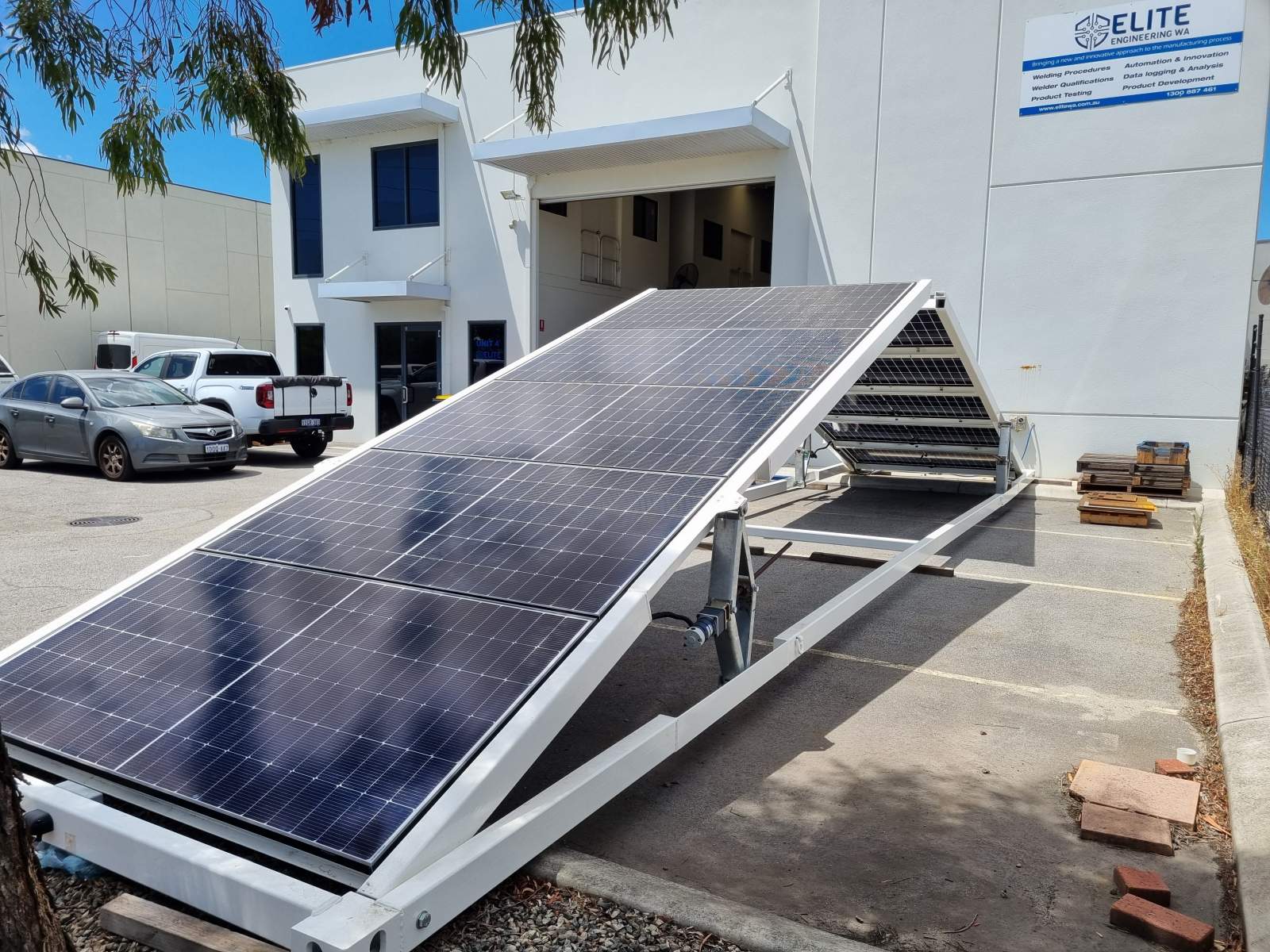
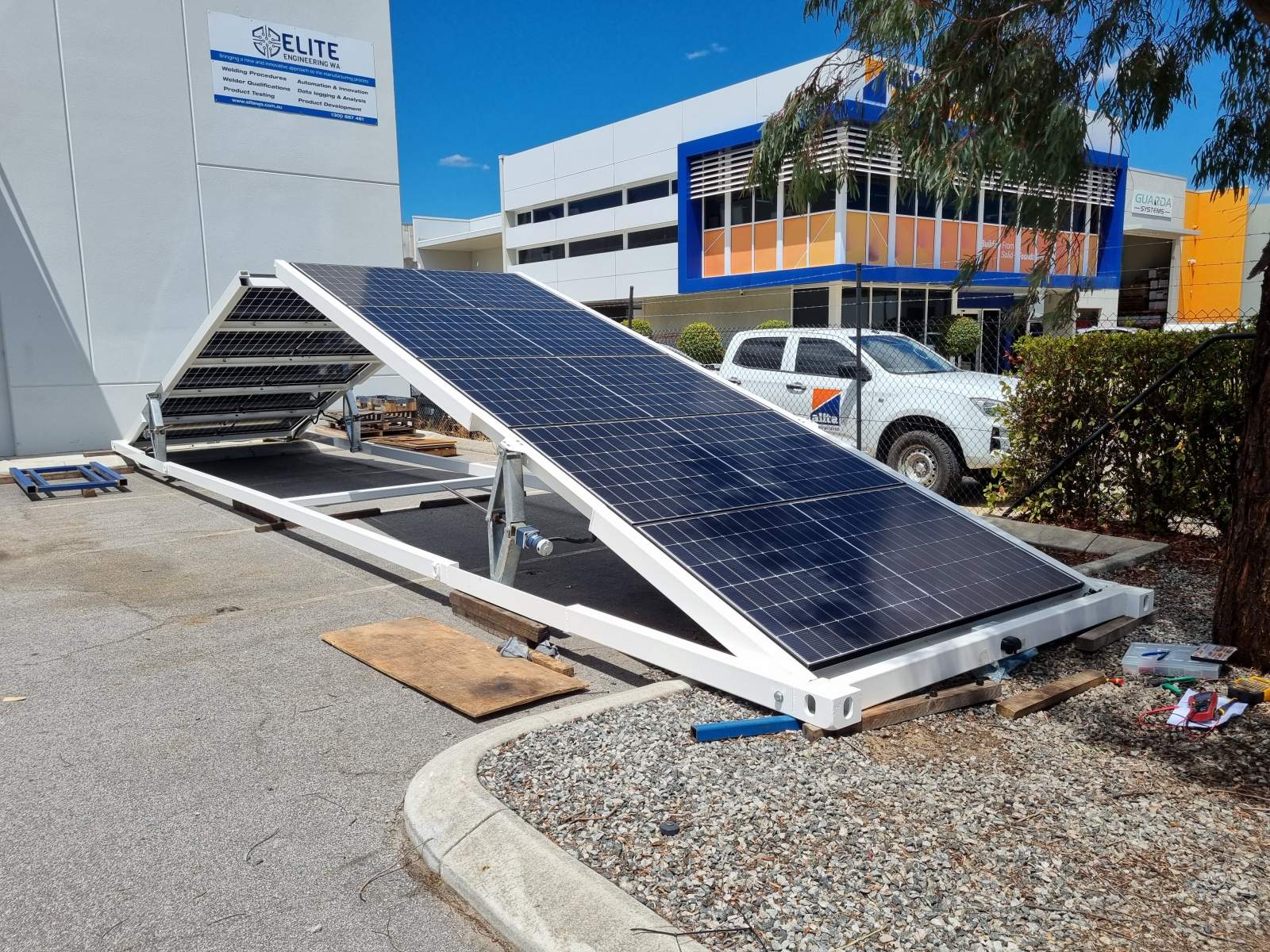
40ft container solar frame in the inclined position — tilted to 20° for maximum solar capture, with the container battery system powering the actuators
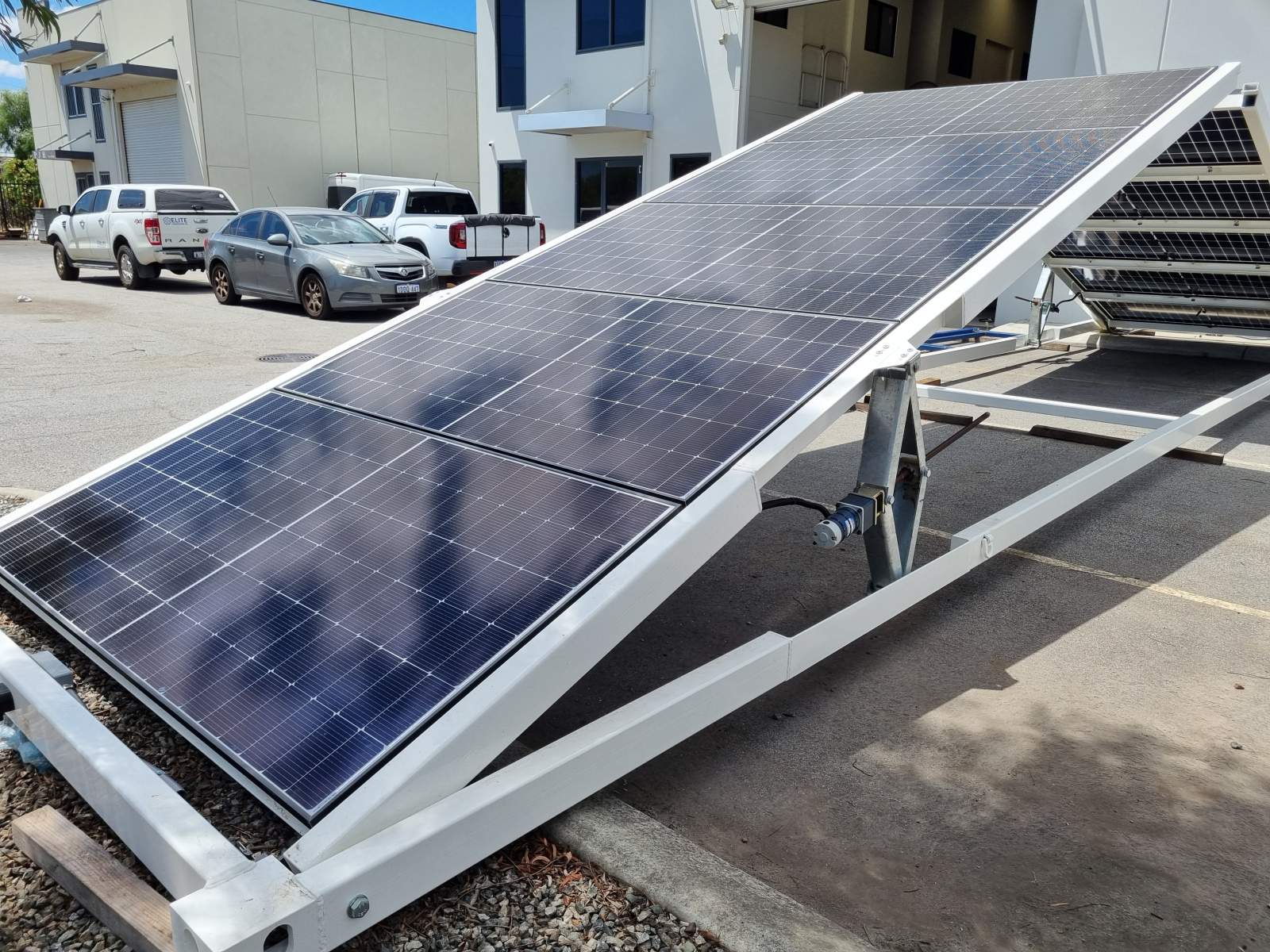
Low-profile actuator mechanism — designed to keep the frame within standard transport envelope when laid flat, avoiding oversize permits
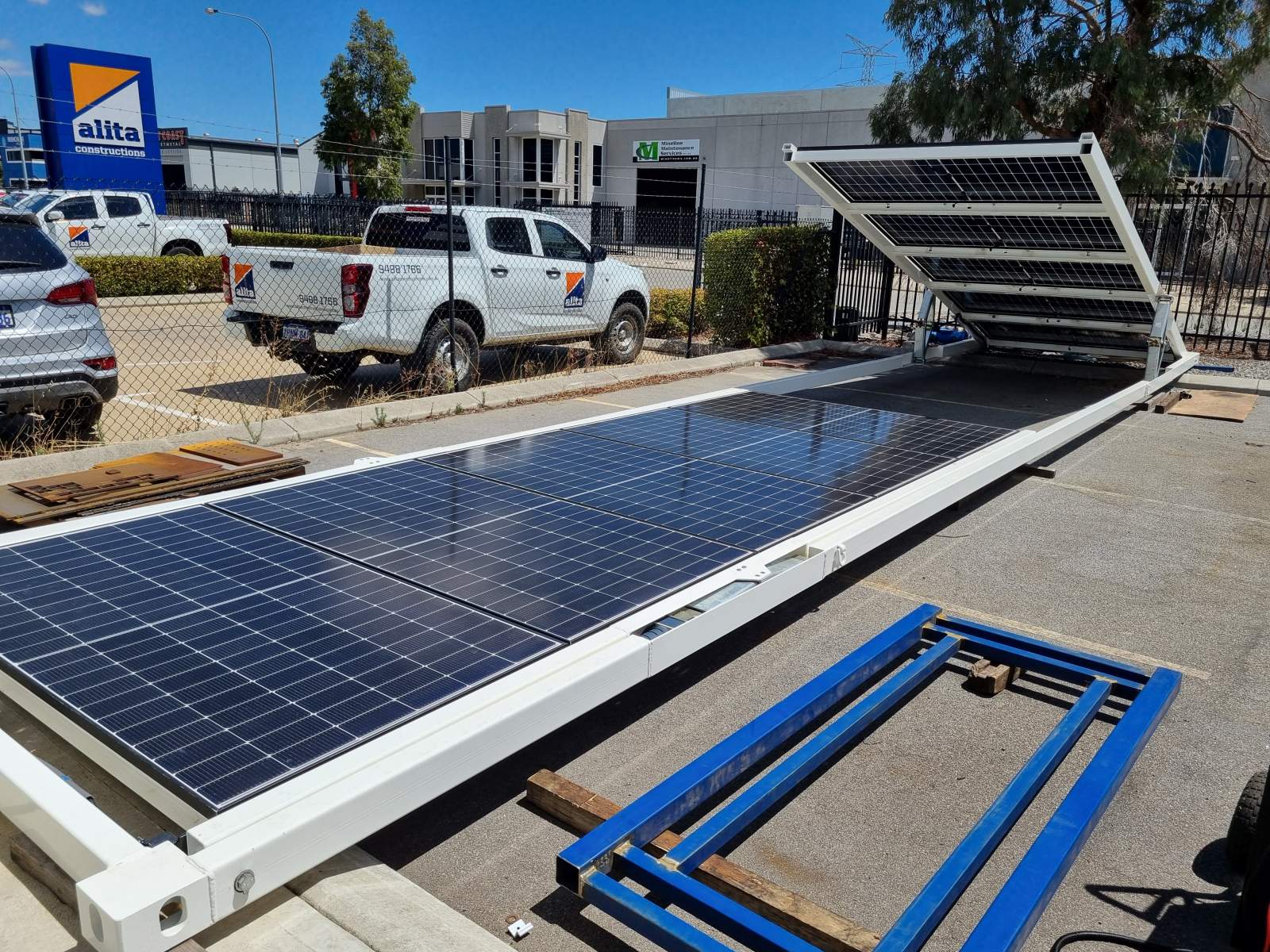
Frame in the flat transport position — low enough to travel attached to the container on a standard road train without oversize permits
48V battery bank and actuator power system housed inside the container — the solar array charges the batteries that operate the actuators
Project Details
- Location
- Port Hedland, Western Australia, Australia
- Sector
- Renewable Energy
- Status
- Completed
- Project Value
- $$$$$
- Completion Date
- March 2025
- Standards